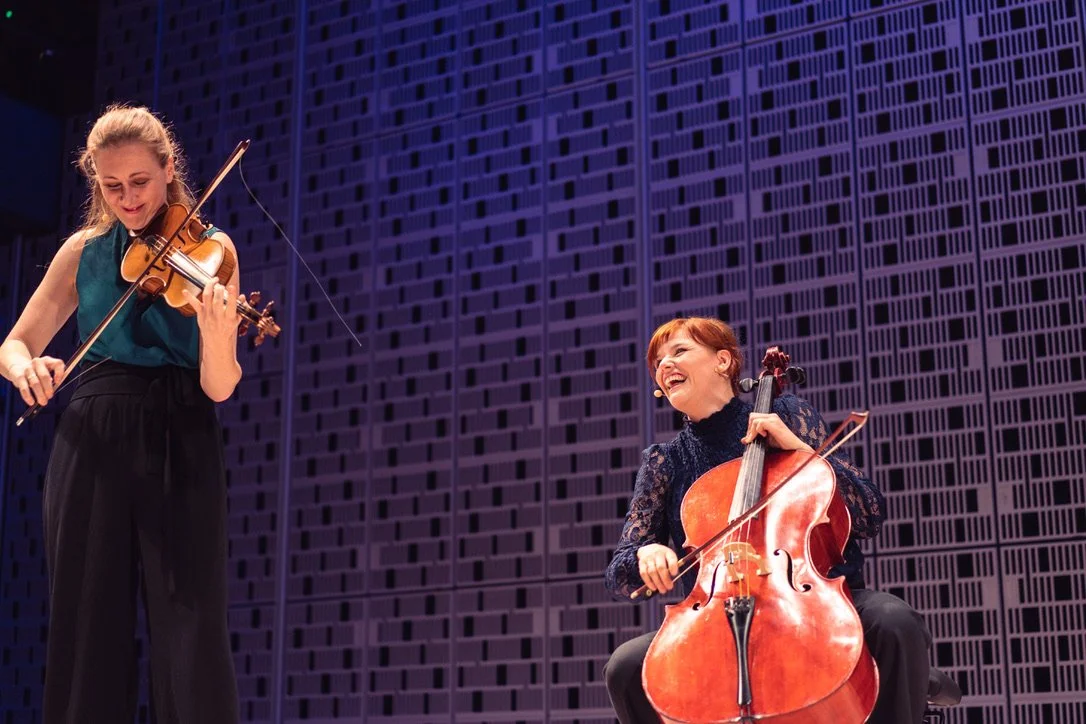
Moments from Live Performances
”Don’t you find that there is always something lost, when recording improvised moments?”
Yes, absolutely - The magic of improvisatory moments comes from their dialogical character, conversing with the past and present, uniquely reflecting the moment at hand. However, being able to study the musical formats, techniques and styles of classical improvisation is valuable for expanding understanding of the art form itself. These videos are example moments from live concerts, showing different types of improvisatory elements.
free improvisations
Independent of repertoire
ensemble improvisation “love at first sound” concert
At the end of our first Love at First Sound Concert in London, we finished with a freely improvised reflection on the journey we have just shared with the audience. Having performed repertoire from composers including Bach, Dvorák and Berlioz, we finished the programme with gratitude to those composers (how many quotations can you count?) as well as the audience members present.
Milton Court Concert Hall, London, 3/2022
three musical postcards:
mini improvisations on audience requests
In this segment of the concert (Love at First Sound, Helsinki Music Centre), we asked the audience members if they would like to send musical messagas, or Musical Postcards, to someone. The audience member could film it with their phone and send to whom they wished. The three messages on this video clip are:
1) “Encouragement to my son who has had a hard time in school”
2) “I’m sorry for what I said the other day” (to a loved one)
3) “I want to make you regret not coming to this concert with me”
audience request: prayer for ukraine
Free improvisation on audience request. London, March 2022.
Repertoire-related improvisations
Debussy: Using a written piece as ‘A’ part in a chamber music sonata form (A-B-C-A1)
Roussel: Using the written opening theme for ”Theme and (improvised) variations”
Berlioz: Improvised Postlude after the written piece
Schubert: Improvised arrangement by ensemble, with piano score as source
Debussy: girl with flaxen hair & improvised story performance
The written piece is first performed for piano and cello, after which the ensemble launches into an improvisation with the storytelling premise, Who is this girl and what happened to her next?
After the freely improvised part (B and C sections), the ensemble returns to play the composed text but with improvised elaborations (following the structural approach of A-B-C-A1).
flute duo improvises on roussel’s “Joueurs de flûte, Op. 27 (1924)"
A flute & piano duo include improvisation in their performance by using a "Theme & Variations" structural approach. In this performance, the opening theme (6 bars) of Roussel's "Joueurs de flûte" becomes improvisatorically developed through variations and interludes that bind them together.
Catherine Dreher, flute (HKB, Switzerland) & Hannah Csérmely, piano (RNCM, UK)
hector berlioz: la captiva, op 12, with improvised postlude
After performing the written piece, we launch into an improvised reflection. Lyrics (English) are also improvised, using inspiration from the original (French) text.
improvised arrangement of schubert’s ständchen, including instrumental prelude and postlude
Using the original score for voice and piano as starting, we improvisatorically created a trio accompaniment using the piano score.
Improvised trio minuet, inspired by Bach’s cello Minuet
This trio Minuet follows the performance of J. S. Bach’s solo cello Minuets d-minor I & II. The string trio improvises a string Minuet in response to Bach’s solo cello Minuets.
Hugo Wolf: Mausfallensprüchlein
theme & improvised variations
Turning the written song into a Theme, followed by Improvised Variations.